
Your partner is Turkish, their family doesn’t speak much English, and every visit you smile, nod and wait for someone to translate. This is a plan to change that, one dinner at a time.
I hear this story more than any other.
Your partner speaks perfect English. Their mom, dad, aunts and cousins don’t. So at every family dinner, the conversation flies around the table in Turkish, everyone laughs at something, and you laugh a second later because everyone else did 😅
Then there’s the video call with the mother-in-law, where all you can do is wave and say “Merhaba!” while your partner translates.
I’ve seen this from the other side of the table: my wife Sarah isn’t Turkish, and I watched her learn it. And of the students who tell us why they’re learning, about one in five are doing it for exactly this reason: their partner’s family.
The good news: you can feel part of the family long before you’re fluent. It takes the right words, the right order, and a little practice at every visit.
The short answer: start with the family words and the 20 phrases Turks use at every visit, learn the basics of Turkish in order (A1, then A2), train your ears for fast family talk, and use every visit and video call as practice. Don’t rely on your partner as your teacher. At 20 to 30 minutes a day, most people can follow simple family conversations in about 3 months and have simple conversations with their in-laws in about 6 months.
On this page
- What happens at a Turkish family dinner
- Step 1: Learn the family words
- Step 2: Learn the 20 phrases you'll use at every visit
- Step 3: Learn to understand before you speak
- Step 4: Follow one path for the grammar (and don't make your partner your teacher)
- Step 5: Turn every visit and video call into practice
- Step 6: Ask your partner for the right kind of help
- How long until I can talk with my in-laws?
- The mistakes that keep partners stuck
- Where Turkishle fits
- Frequently asked questions
- The bottom line
What happens at a Turkish family dinner
Here’s what a normal moment at a Turkish family dinner sounds like. If you learn just these lines, you’ve already got through the first ten minutes:
🍽️ At the dinner table
🙂
🙂
🙂
A few things to notice:
- Your mother-in-law may call you “kızım” (my daughter) or “oğlum” (my son). That’s a good sign. It means you’re family.
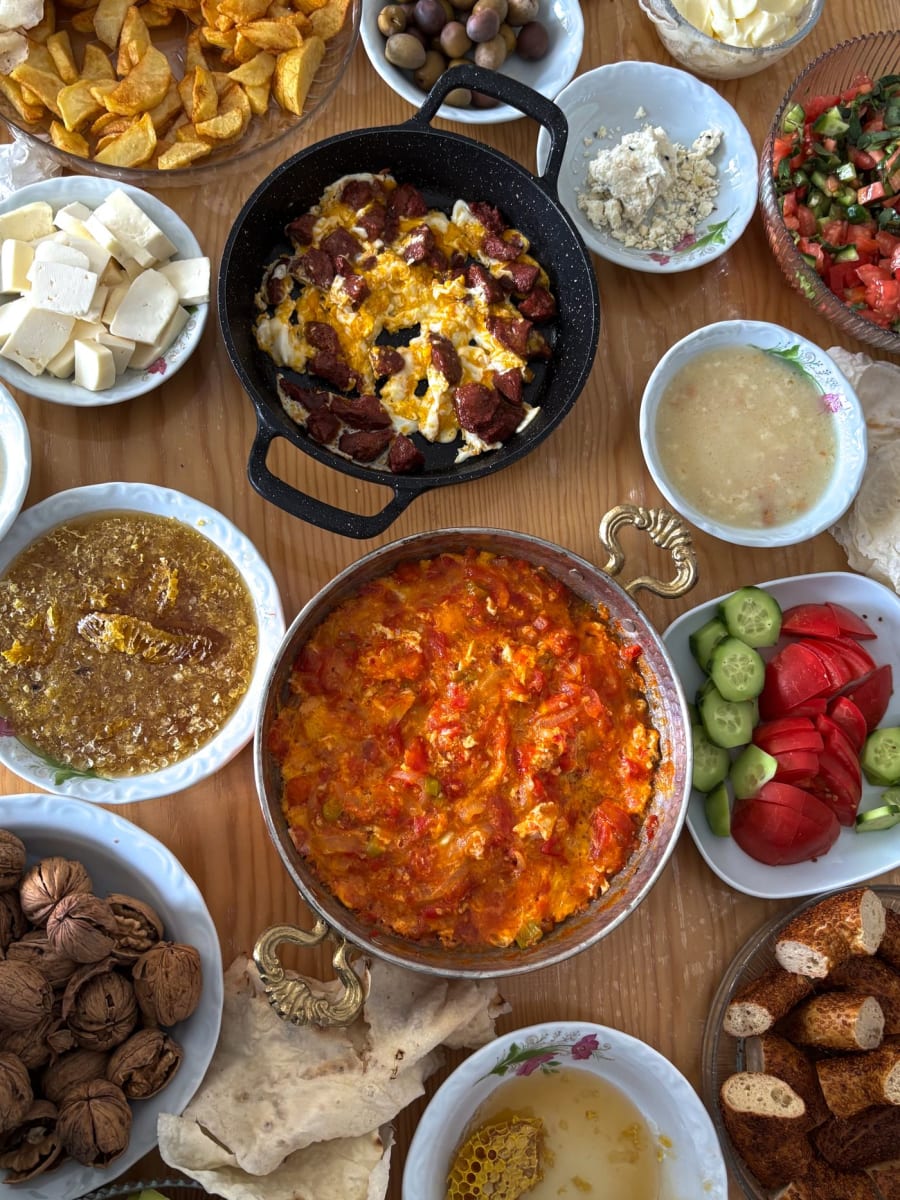
- Food is how Turkish families say “I love you”. You’ll be offered more food many times. Saying something nice about the food matters more than perfect grammar.
- Everyone talks at once, fast. You won’t follow everything at first. Nobody expects you to.
Step 1: Learn the family words
Turkish has a different word for almost every family member. Your partner’s sister has her own word, and so does your partner’s brother’s wife. You’ll hear these words in every family conversation, so learn the ones that apply to you first.
👪 Parents-in-law
🧑🤝🧑 Siblings-in-law
👵 Grandparents
🧓 Aunts and uncles
What do I call my parents-in-law? Many people simply call them anne (mom) and baba (dad), and Turkish parents usually love it. Ask your partner what feels right in their family. Until then, a warm “Nasılsınız?” (How are you?) works with anyone.
Step 2: Learn the 20 phrases you’ll use at every visit
These are the phrases Turks say at family visits, meals and holidays. Most of them don’t translate word for word, which is why apps rarely teach them. Learn them before your next visit and watch the reactions 🙂
One more tip: use “siz” with the older family members. Turkish has two ways to say “you”: sen (friendly) and siz (polite). With your parents-in-law and older relatives, use siz: “Nasılsınız?”, “Ellerinize sağlık”. It shows respect, and older Turks notice.
Step 3: Learn to understand before you speak
At family dinners, you’ll listen far more than you talk. So your ears need the most practice.
The problem: family talk is fast, people interrupt each other, and they use a lot of everyday words that textbooks skip. You can read a dialogue perfectly and still catch nothing at the table. That’s normal.
What helps:
- Listen to Turkish made for learners first, slow and clear, then move to natural speed.
- Listen to the same audio many times. The first time you’ll catch 20%, the fifth time 70%.
- Watch Turkish family scenes in series or YouTube videos, with Turkish subtitles once you can.
- At the table, listen for the words you know. You don’t need every word to get the topic.
When you start understanding what the family is talking about, even without answering, everything changes. You stop feeling outside the conversation.
Step 4: Follow one path for the grammar (and don’t make your partner your teacher)
Speaking Turkish and explaining Turkish are two different skills.
Ask a Turk why it’s “evde” but “okulda”, and most will say “it just sounds right” 😄 They learned it as children and never had to explain it. Lessons with your partner also tend to turn into arguments, and that’s the last thing you need.
So learn the grammar from a structured path, in order: A1 first (the basics, present tense, the most common suffixes), then A2 (past and future, longer sentences). A good textbook, an online course or a teacher all work. The important part is that it’s one path, in the right order.
Let your partner do what they’re great at: talking with you in Turkish.
Step 5: Turn every visit and video call into practice
Small, regular moments are enough:
- Set one goal per visit. “This time I’ll ask my mother-in-law how she made the dolma.” Then do it.
- Prepare 3 sentences before each video call. Something about your week, a question for them, a nice wish at the end.
- Cook together. Kitchens are the best Turkish classroom. You see the thing and hear the word at the same time, and nobody minds if you make mistakes.
- Say what you can’t say. “Yavaş konuşur musunuz?” (Could you speak slowly?) is a full sentence, and families are happy to slow down for you.
Your first conversations will be slow and full of mistakes. Turkish families are very forgiving about that. They’re just happy you’re trying, I promise.
Step 6: Ask your partner for the right kind of help
Your partner can make this much easier. Ask them to:
- Speak Turkish with you for 10 minutes a day, at dinner or on a walk. Short and regular beats long and rare.
- Not translate everything at family events. Let you try first, and step in only when you’re really stuck.
- Tell you the topic when the family talks fast (“they’re talking about cousin Mehmet’s wedding”). Knowing the topic is half the battle.
- Be patient. You’re doing something hard, for their family.
How long until I can talk with my in-laws?
At 20 to 30 minutes a day:
Everyone moves at a different speed. Some students get there faster, and some take longer because of work, kids and life. What matters most is a little every day.
The mistakes that keep partners stuck
- Waiting until your Turkish is “good enough” to speak to the family. That day never comes. Start with “Eline sağlık” at the next dinner.
- Letting your partner translate everything. It’s easier for everyone in the moment, and it keeps you outside the conversation for years.
- Using only an app. Apps don’t teach you “Hoş bulduk” or “Kolay gelsin”, and they won’t get you to real conversations.
- Learning random words instead of the basics in order. You need the grammar to understand what people say to you.
- Saving it for the next trip. Cramming for two weeks before a visit doesn’t last. 20 minutes a day does.
Where Turkishle fits
You can follow this whole plan without us. A good textbook, your partner for conversation, and a lot of listening will get you far.
If you want everything in one place, this is what we built:
- Free 7-Day Starter Course: 15-minute daily lessons for complete beginners. No credit card needed.
- Our A1 to B2 courses: one path in the right order, short video lessons, exercises after every lesson, real-life dialogues for your listening, and Turkish teachers who answer your questions. Lifetime access and a 365-day money-back guarantee.
- VIP Speaking Program: 12 weeks of speaking sessions with a personal coach, for people who understand Turkish but freeze when the family talks to them.
Want to try Turkishle first?
Start with our free 7-Day Starter Course: 15 minutes a day, no credit card.
Frequently asked questions
How long does it take to learn Turkish to talk with my partner’s family?
At 20 to 30 minutes a day, most people can follow simple family conversations in about 3 months and have simple conversations in about 6 months. Relaxed, longer conversations usually take about a year (B1 level).
Can my Turkish partner teach me Turkish?
They’re great for conversation practice. Most native speakers can’t explain the grammar, though, and lessons between partners often get frustrating. Learn the grammar from a structured course or a teacher, and practice speaking with your partner.
What should I call my Turkish mother-in-law?
Many people call her “anne” (mom), and most Turkish mothers love it. The formal word is “kayınvalide”. Ask your partner what’s normal in their family.
What do I say when I arrive at my in-laws’ house?
They’ll say “Hoş geldin!” (Welcome!) and you answer “Hoş bulduk!” (literally “we found it pleasant”). Then “Nasılsınız?” (How are you?). That’s a perfect start.
Should I use “sen” or “siz” with my in-laws?
Use “siz” (the polite “you”) with your parents-in-law and older relatives, unless they tell you otherwise. Use “sen” with your partner’s siblings and cousins your age.
What do I say after a meal at my in-laws’?
“Ellerinize sağlık” (literally “health to your hands”), to whoever cooked. It’s the nicest thing you can say at a Turkish table.
The bottom line
You can be part of your partner’s family long before your Turkish is perfect. Learn the family words, use the 20 phrases at your next visit, learn the basics in order, and practice a little at every visit and call.
The first time your mother-in-law laughs at something you said in Turkish, you’ll know it was worth it 🙂
Kolay gelsin (may it come easy), and good luck at the next family dinner.
Görüşürüz,
Can
Founder of Turkishle
Keep reading
- 50 basic Turkish phrases with pronunciation
- I live in Türkiye and still can’t speak Turkish: why it happens and how to fix it
- How to learn Turkish: a step-by-step plan
- How long does it take to learn Turkish? A realistic timeline by level
- Is Turkish hard to learn? What’s hard, what’s easy
- Best online Turkish courses in 2026: 10 options compared
- Turkishle review 2026: what 150+ students say
- Take the free Turkish level test
